

ComNets showcases 6GEM+ and PANGOLIN Networks at MWC 2026
- News
- 6GEM+
- PANGOLIN Networks


Within the 6GEM+ project, we demonstrated O-RACES (Open RAN Real-Time AI-Coordinated Efficient Scheduling), a framework designed to support real-time communication in future 6G systems. In the demo, sixteen virtual humanoid robots traverse uneven terrain while being controlled entirely from an AI edge cloud via a real-world open 6G research testbed. The robots offload computationally intensive AI tasks to the network and exchange high-rate sensor data and motor control commands at 150 Hz, enabling stable locomotion with millisecond-level latency. By predicting upcoming uplink traffic and allocating radio resources proactively, O-RACES reduces delay and improves efficiency compared to conventional reactive scheduling methods, enabling scalable real-time control of robotic systems.
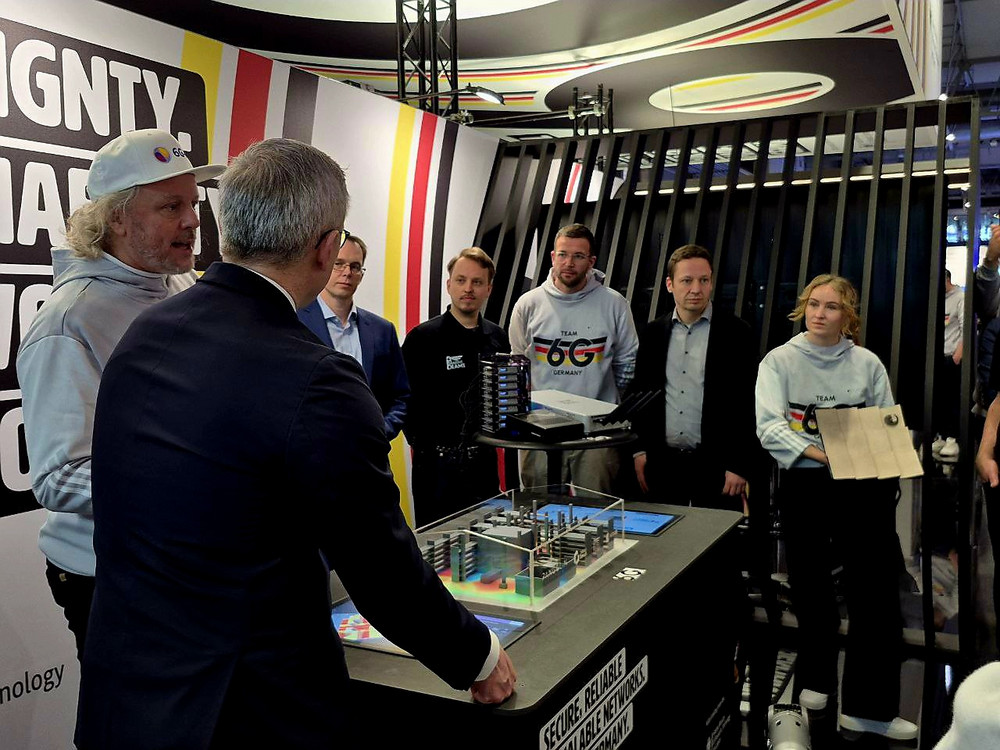
Together with three other startups, we presented PANGOLIN Networks as part of the startup.connect initiative. In our demonstrator we joined forces with CampusGenius, Massive Beams and airpuls GmbH to deliver a modular, private 5G/6G solution developed in Germany. The live system demonstrated how industrial communication networks can be deployed and operated independently of non-European vendors, highlighting a practical approach to technological sovereignty.
The PANGOLIN contributions focused on AI-assisted network planning including IRS for industrial environments. Using our AI-based channel modeling approach DRaGon, highly accurate connectivity maps can be generated significantly faster than traditional methods such as ray tracing. This enabled rapid evaluation of network coverage in a representative industry scenario with a certain quality of service target.
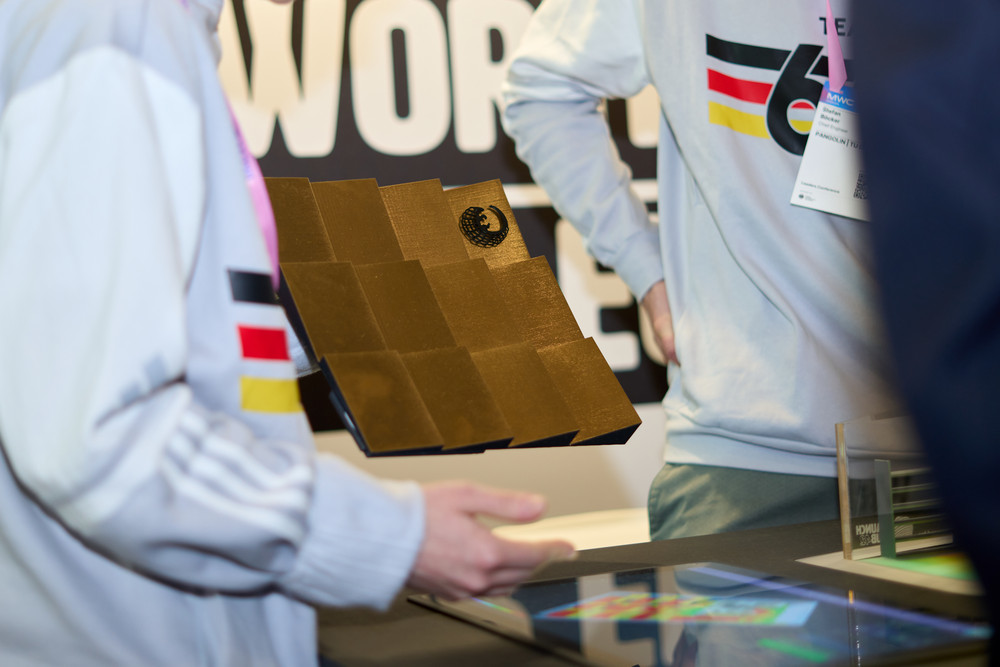
To address coverage gaps, we illustrated the combination of conventional active radio units with our passive reflectors HELIOS, which are tailored to the deployment environment and provide efficient options to illuminate uncovered areas. By strategically deploying these passive components, comparable connectivity can be achieved while significantly reducing costs, installation efforts and energy consumption compared to purely active network densification.
Together, the demonstrator illustrates how AI-driven network planning, passive radio components, and continuous monitoring enabled by STING can support scalable, high-performance, and sustainable wireless networks for future industrial communication systems.
During the event, the 6G Germany booth was also visited by Dr. Karsten Wildberger, Federal Minister for Digital Transformation and Government Modernization. Prof. Frank Fitzek introduced the startup demonstrator featuring PANGOLIN Networks and its role in the joint showcase on technological sovereignty. Minister Wildberger expressed strong interest in the presented industry-oriented solutions and highlighted their potential to contribute to strengthening technological sovereignty from and for Germany.
Further information:
- N. A. Wagner, C. Wietfeld, "O-RACES: Proactive AI-driven scheduling in Open RAN for 6G-networked humanoid robots," in IEEE INFOCOM Workshops, NetRobiCS Workshop on Networked Robotics and Communication Systems, Tokyo, Japan, May 2026. [Details]
- PANGOLIN Networks Project Homepage: https://pangolin-networks.de/